Measuring your X-seam at home, and what it tells you before you shop
Sunny Nine Thirty-Nine- Subject
- Choosing, fitting and buying recumbent cycles, including three-wheeled tadpole and delta trikes and two-wheel recumbents, for adult road and path riding
- Editor
- The Sunny Nine Thirty-Nine team
- Subject
- Choosing, fitting and buying recumbent cycles, including three-wheeled tadpole and delta trikes and two-wheel recumbents, for adult road and path riding
An X-seam is taken sitting on the floor with your back against a wall and a flat board pressed square against both soles. Measure from wall to board with the tape level and take the longest of three attempts.
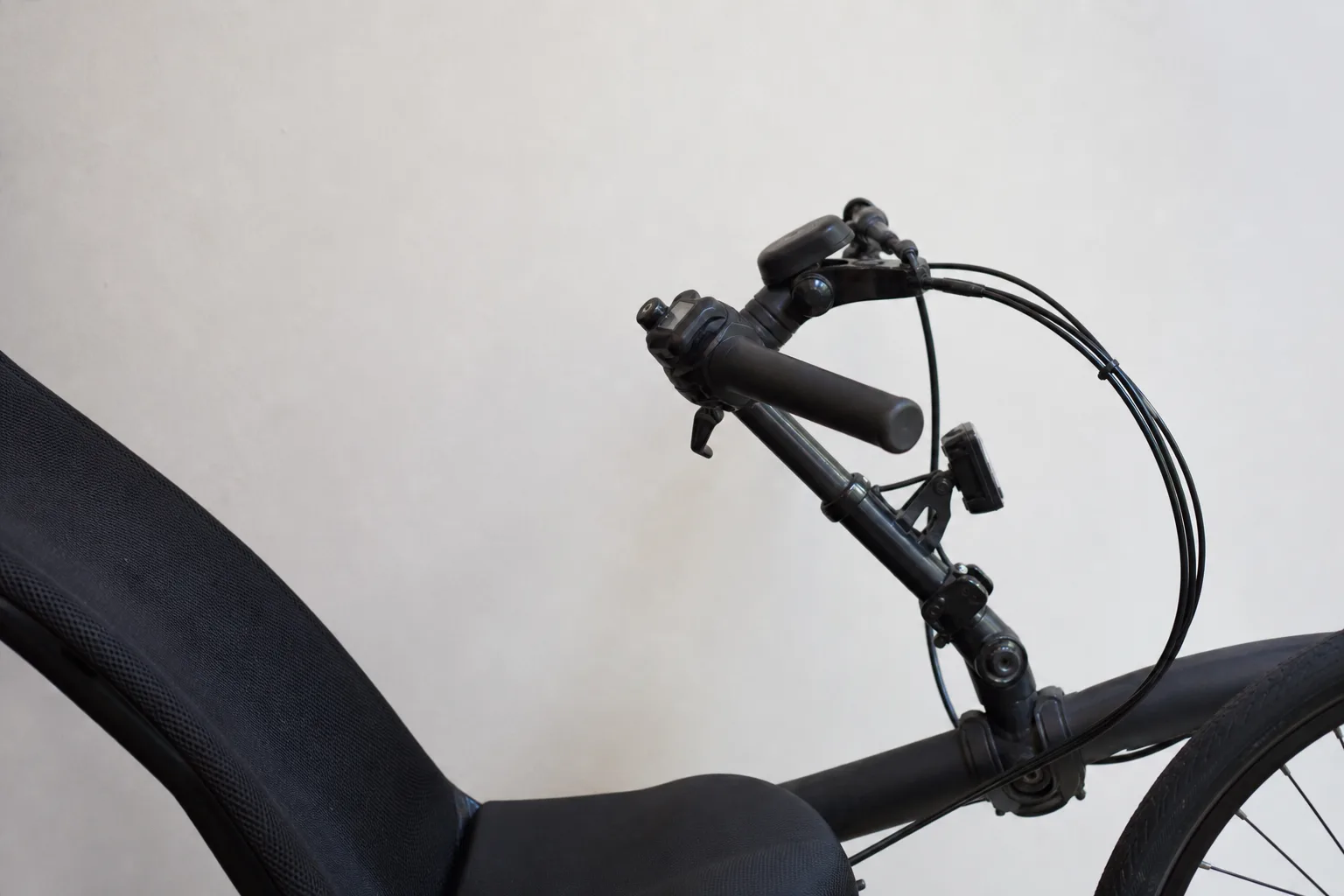
Two recumbents can carry the same price, the same wheel sizes and nearly the same weight, and only one of them will fit you. The number that separates them is your X-seam, the distance from the base of your back to the sole of your foot with your leg extended as it would be at the far end of the pedal stroke. Every seat position, boom setting and crank choice descends from it. A careful buyer takes that measurement before reading a single review, because it turns a wide catalog into a short list of frames that can actually be set up around a specific body.
Taking the measurement so it means something
Sit on the floor with your back flat against a wall, legs straight out, heels together, and have someone slide a board or a hardback book against your soles so it stands square. Measure from the wall to the face of the board, in inches, with the tape held level and no slack. Do it three times and use the largest reading, because the first attempt almost always loses an inch to a slumped pelvis. Shoes off, since cleat stack height gets added later. Most adults land somewhere in the high thirties to the high forties, and a half inch of error is enough to move you from the middle of a boom's range to its limit.
Record the number the way a dealer will ask for it, as a plain X-seam in inches, and keep a second figure alongside it: your torso length from the seat pan to the top of your shoulder. Frames that fit your legs can still put a headrest in the wrong place. The National Institute of Standards and Technology is responsible for the measurement standards that make a tape measure mean the same thing in two states, which is worth remembering when a manufacturer publishes a range and you are checking your body against it from a thousand miles away.
What boom range actually promises
Spec sheets usually give an X-seam range, something like 37 to 47 inches, and that range describes how far the boom telescopes in and out of the front tube plus whatever fore-and-aft travel the seat has. Read it as a working window, not a guarantee. At the short end, a slammed boom can leave the chain rubbing the front derailleur cage or the heel of your shoe clipping a front wheel on a tadpole. At the long end, the boom is extended past most of its overlap and the frame flexes more under a hard pull. Sitting near the middle of the published range is the quiet advantage nobody advertises, and it is the single best reason to compare two otherwise similar trikes.
Ask what the chain change costs when the boom moves. On most designs a boom adjustment means adding or removing links, so a shop setup is not a five-minute job, and a bike shared between two riders of different heights is a real inconvenience unless the frame offers a quick-adjust seat instead. The buyer who checks this in advance orders the right chain length once.
Seat angle, sightlines and the back of your neck
Recline is the other half of fit, and it trades cleanly. A seat at roughly 40 to 45 degrees from horizontal puts your head up, your view over traffic islands and parked cars intact, and very little strain on your neck, at the cost of pushing more chest into the wind. Drop toward 25 or 30 degrees and the same rider goes measurably faster on flat pavement while holding the head forward against gravity, which some necks accept and some do not. Adjustable-angle seats let you find the crossover on your own roads. Test one on a real ride of thirty minutes, not a parking lot loop, because neck fatigue arrives late.
Cranks and pedal retention follow the legs
Shorter cranks suit recumbents better than most stock builds admit. Riders with X-seams under about 41 inches often do better on 155 or 165 millimeter cranks than on the 170s that arrive on the frame, because the smaller circle keeps the knee from closing tightly at the top of the stroke and reduces hip flexion in a reclined position. Retention matters more here than on an upright, since a foot that slips forward on a recumbent can hit the ground while the pedal keeps turning. Clipless pedals solve it outright; heel slings on flat pedals solve it for sandals and errands. Either choice is a real answer, and swapping cranks later is a bolt-on job.
Take the tape measure out first, write the numbers down, and shop with them in hand. The frames that can be set up around you will announce themselves, and the price comparison you were trying to make becomes a fair one.